Can the European Routes of Jewish Heritage Help Foster Dialogue for Peace in Europe Today?
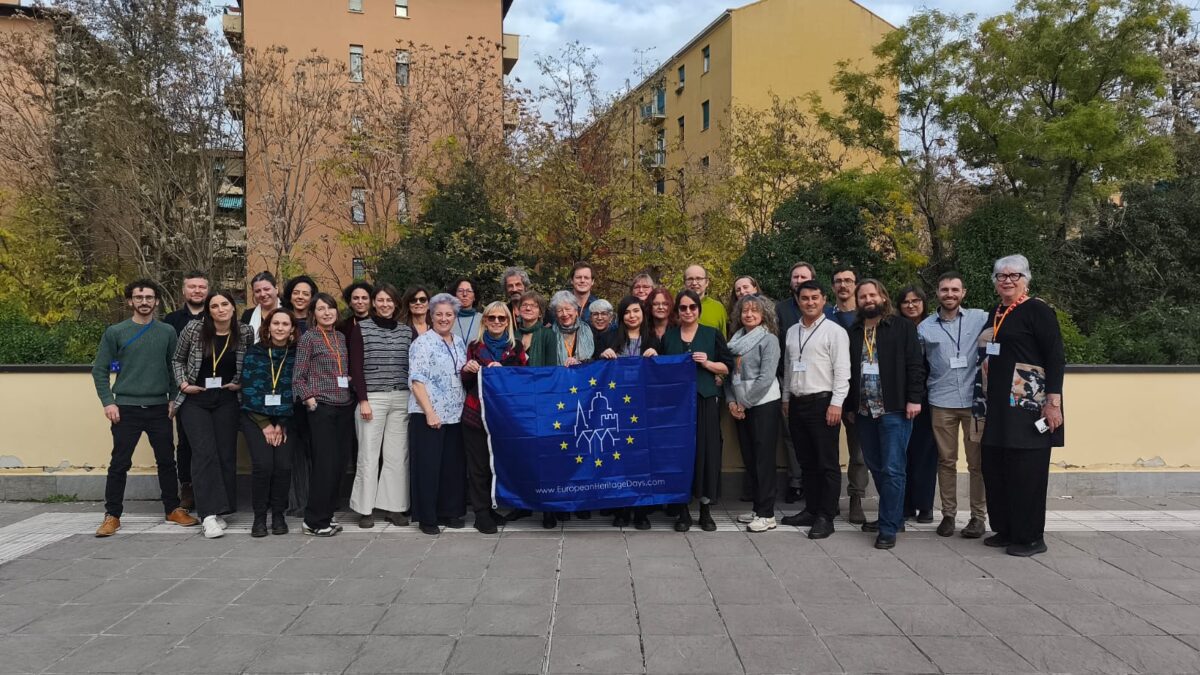
This month, AEPJ has brought to completion yet another cornerstone of our work: the European Routes of Jewish Heritage Incubator, which this year unfolded in the evocative settings of Bologna and Forlì.
This is a yearly event organised by AEPJ with the support of European Heritage Days for our route managers to network and share their knowledge and experiences in order to better strengthen our network. This year’s edition, ERJH 2025: Interpreting Architecture, Fostering Dialogue for Peace, brought together 37 Jewish heritage professionals who are all working to develop the ERJH across Europe.
Following a week of introductory online sessions, which you can read about here, we opened the in-person programme with a warm welcome in Bologna, where participants were invited to step directly into the city’s rich Jewish history with a guided walk through the old Jewish quarter, including a visit to the Jewish Museum and Synagogue, setting the stage for the days ahead.

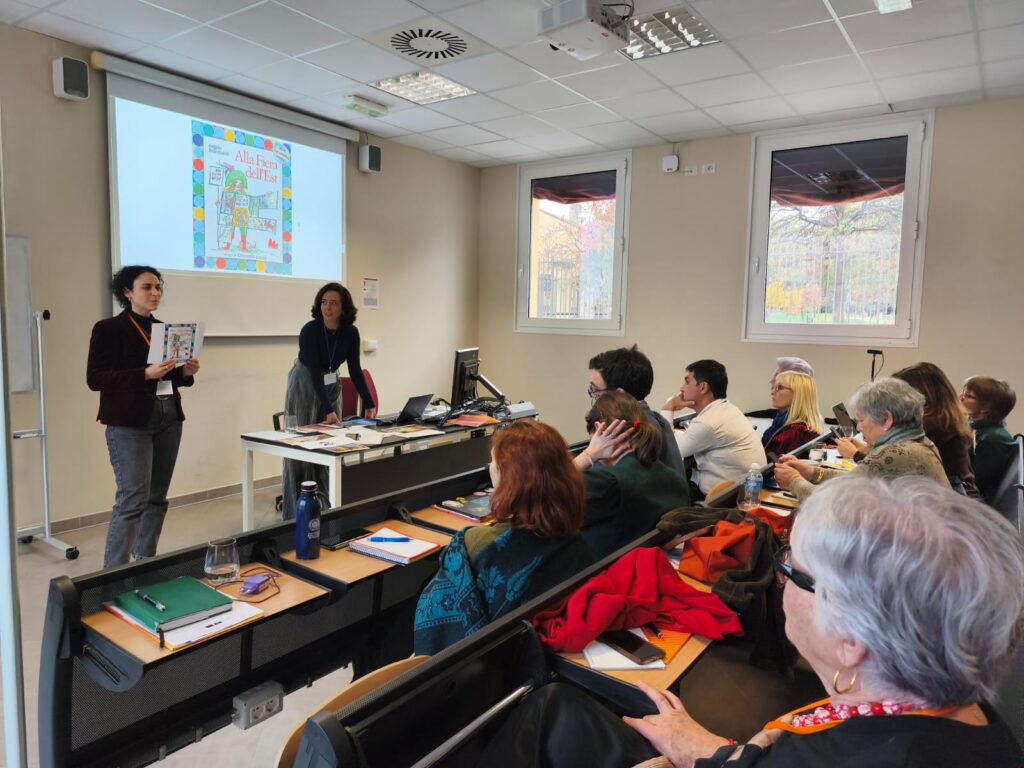
The following day, the Incubator turned its attention to one of our core missions: interpreting heritage in ways that foster dialogue, understanding and peace. Prof. Alessia Mariotti, a researcher at the Centre for Advanced Studies on Tourism of the University of Bologna (CAST UNIBO) and one of the minds behind ATRIUM, led the first session on coping with “dissonant heritage,” drawing on ATRIUM’s challenging work with the preservation of architectural legacies of totalitarian regimes. Participants explored how challenging buildings and spaces can hold multiple meanings, and how participatory approaches can transform tension into shared memory work.
From there, Jack Shepherd invited us to notice the quieter, everyday markers of belonging—foods, shops, neighbourhood stories—that make Jewish heritage feel rooted and alive. Through a hands-on workshop, participants designed their own “everyday Jewish heritage indicators,” imagining the signals of thriving community life along our Routes. The day concluded with the Mi Dor Le Dor Italy partners, who showcased some of their actions linking local narratives with Jewish history and culture.
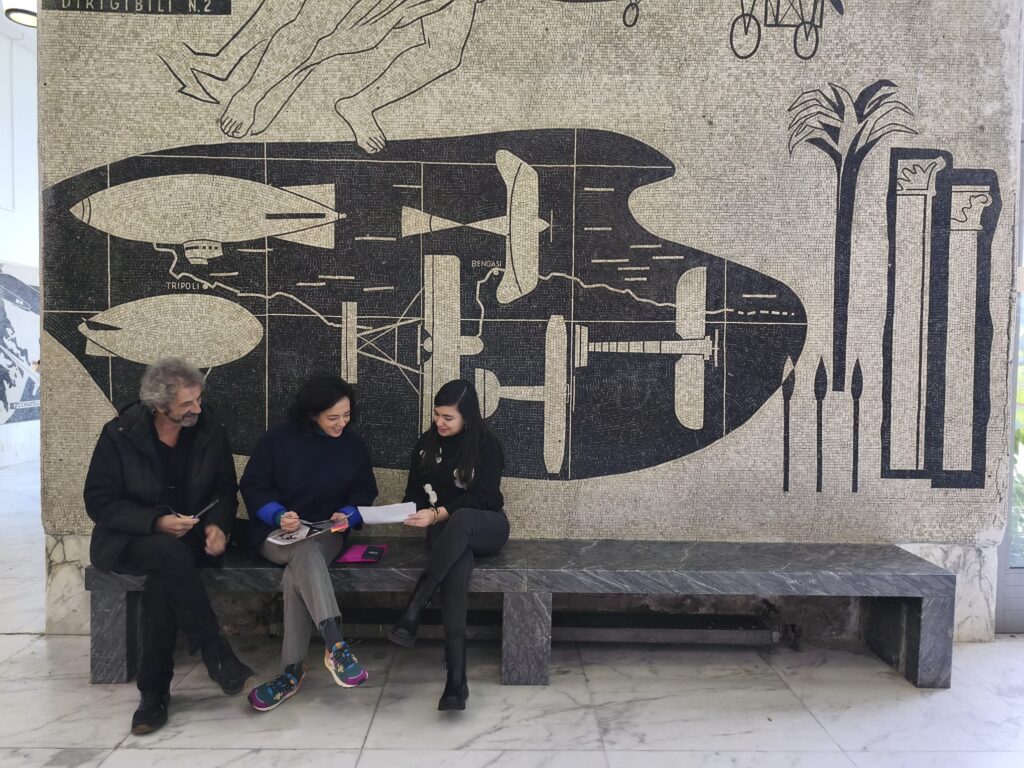
Our visit to Forlì the following day, organised by DEINA, deepened the reflection. Walking along Viale della Libertà, participants engaged with ATRIUM architecture through an interactive gamebook focused on childhood under fascism. We then stepped inside the former Bruno Mussolini Aeronautical College, where we were invited to examine Angelo Canevari’s mural from fascist times, sparking a debate on whether such works should be preserved in educational settings, and if so, how. In the afternoon, Maria Laura Gasparini (also a researcher at CAST UNIBO) guided us through strategies for governance and sustainability in transnational cultural networks, and the AEPJ team also shared with the participants an update on the improvements planned for ERJH communication in 2025.
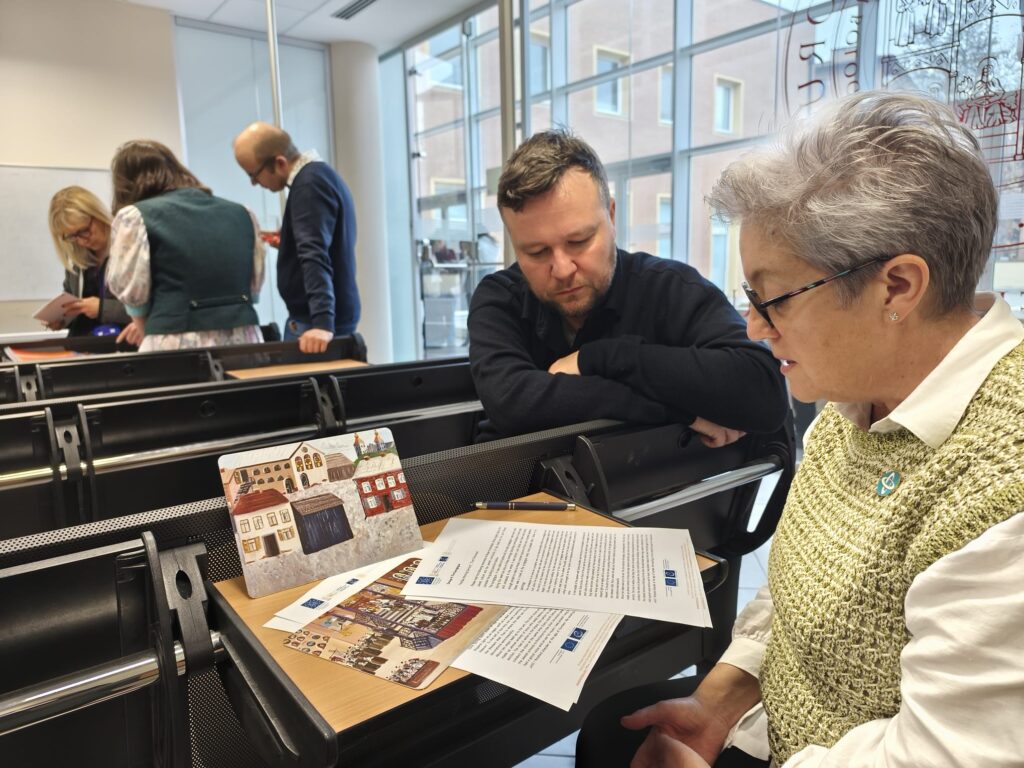
The last day brought us full circle, reconnecting difficult heritage with the power of storytelling and shared memory. Licia Calvi presented the JEWELS TOUR project, demonstrating how cities across Europe are re-thinking Jewish cultural heritage to build narratives of peace and mutual understanding. This was followed by Marta Eichelberger-Jankowska’s workshop using Mayer Kirshenblatt vibrant, colourful paintings of life in the shtetl to explore how memory fills the spaces where architecture has disappeared. We then closed the Incubator with a collective wrap-up session.
The incubator as a whole was then concluded the following week with a final online session: Solutions to current challenges conducted by Jeremy Leigh, Hebrew Union College Jerusalem and member of the AEPJ Scientific Committee.
All in all, this year’s Incubator has sparked several lines of work that are bound to nurture long-term results in at least three fields: 1) The contribution of cultural routes to the role of Jewish heritage in the normalisation of Jewish life in Europe, 2) the development of narratives capable of generating greater awareness of Europe’s cultural diversity, specifically drawing on the memory of its Jewish population, and 3) the redefinition of the ERJH’s communicative action in order to better project this diverse yet interconnected narrative.
We extend our heartfelt thanks to all participants and partners. The seeds planted in Bologna and Forlì are already taking root, promising another year of growth for the European Routes of Jewish Heritage.
The European Routes of Jewish Heritage Incubator 2025: Interpretating Architecture, Fostering Dialogue for Peace was produced with the financial support of the European Union and the Council of Europe. Its contents are the sole responsibility of the authors. The views expressed herein can in no way be taken to reflect the official opinion of either the European Union or the Council of Europe.