We are delighted to welcome the Leipziger Notenspur (Leipzig Music Trail) to the AEPJ family.
Rooted in the rich musical legacy of Leipzig, the Leipziger Notenspur connects the musical past and musical present with the city’s architecture, public spaces, green areas and lived urban experience. As holders of the European Heritage Label, they offer music not only as history, but as something to be encountered, walked, heard and felt in the city itself.
A particularly resonant strand of this work is the Jüdische Notenspuren (Jewish Music Trails), which seeks to give the lost heritage of Jewish culture a “home” once again. Through former sites and buildings, interactive formats and a strong educational focus, the project brings German-Jewish musical heritage back into the shared memory of Leipzig—addressing children, residents and visitors alike.
In a city where no physical traces of the medieval Jewish settlement remain, the initiative carefully reconstructs Jewish history from around 1800 onwards. They make authentic places and architecture visible, where Jewish music was composed or performed. Crucially, remembrance here is not passive. Following a deeply Jewish understanding of memory, participants are invited to become active carriers of remembrance themselves. Music plays a central role in deepening this experience.
This approach also shapes how the Leipziger Notenspur addresses Germany’s Nazi period. Rather than reducing Jewish history to victimhood, the project highlights solidarity, compassion, resistance and the cultural and human values that persisted even under persecution. This perspective is embedded in extensive educational work with schools, including student-produced audio clips on persecuted musicians and dedicated teaching materials for different age groups, such as the Notenbogen-Entdeckerpass and accompanying didactic resources.
The initiative also works to restore dignity and visibility to forgotten or overlooked sites of Jewish history. At the former location of the Ez Chaim Synagogue—once the largest Orthodox synagogue in Saxony—visual and audible elements now make the site speak again. A large banner depicting the synagogue and a sound installation featuring original recordings from the 1920s, including those of renowned cantor Nahum Wilkomirski, reconnect the present city with its silenced past.
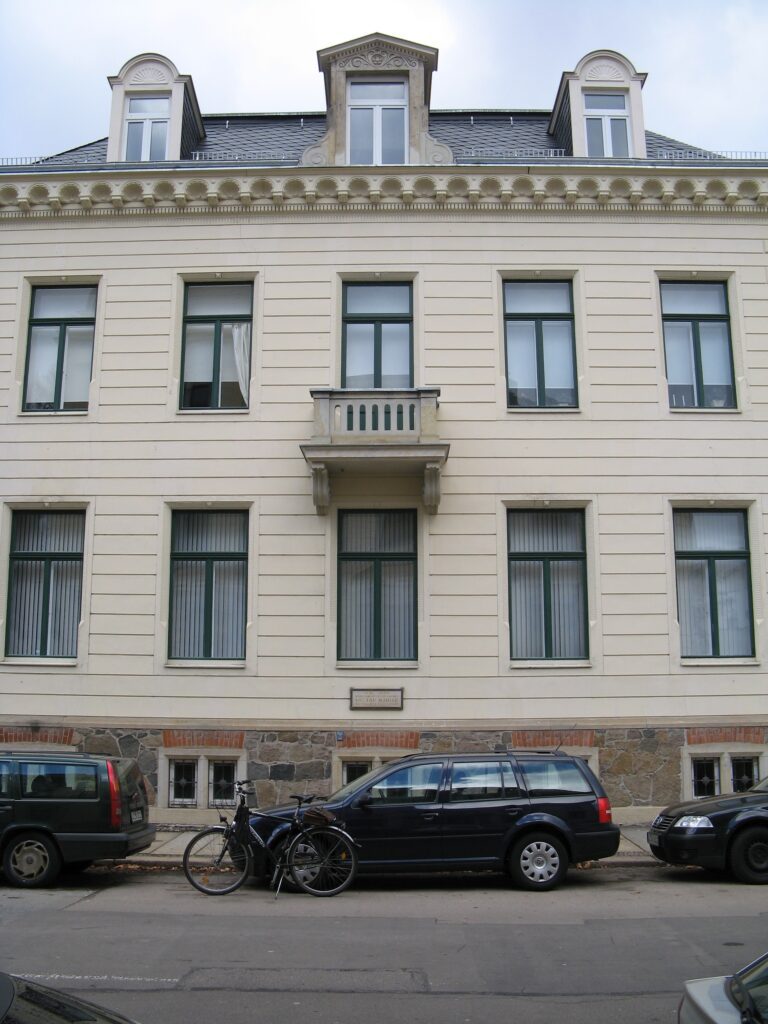
Another example of this localisation of memory is the marking of sites that still exist today, such as the house where Gustav Mahler composed his First Symphony—quietly weaving Jewish musical history back into Leipzig’s urban fabric.
Looking ahead, the Leipziger Notenspur will be contributing to a rich programme of upcoming activities, including the TACHELES 2026 festival year on Jewish culture in Saxony, the Snow Flowers Memorial Walk in April 2026, a concert dedicated to Erwin Schulhoff, and the European Music Trails – Jewish Music in Leipzig festival in November 2026.
We are proud to welcome the Leipziger Notenspur into the AEPJ network and look forward to working together to promote participatory, music-based and place-anchored approaches to Jewish heritage—approaches that make memory resonate in the present and carry it forward into the future.