
Information for coordinators
and participating institutions
European Days of Jewish Culture 2026: Love
Dear EDJC Coordinator,
The central theme of the 2026 edition of the European Days of Jewish Culture festival is:
Love
Read on to find important dates, processes and resources for organising an EDJC 2026 activity. More information will be added to this page soon. For any questions or information please do not hesitate to contact us at edjc@jewisheritage.org.
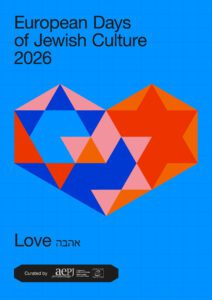
From September 6th, 2026. All Europe
Organising an EDJC 2026 activity
1. Register to the Organisers & Coordinators newsletter
If you haven’t registered yet, please use the following form to stay up to date with all organisational news and updates regarding the EDJC.
2. Download the text about LOVE
Download the inspirational text to start exploring LOVE and thinking about your activities for the EDJC.
3. Watch the recording of the 2026 Online EDJC Organisers & Coordinators Meeting
On May, 2026, we celebrated online the annual gathering that brings together EDJC coordinators, organizers and partners from across Europe. If you did not have the opportunity to attend, you can watch the recordings of the sessions by accessing the following links.
4. Watch the Inspiring LOVE Session
Watch the recording of the session “Is Love a Jewish Idea?” with Prof. Alexis Nouss, an insightful exploration of the concept of love as a source of inspiration for this year’s edition of the EDJC.
5. Download the editable Poster and other visuals
As every year, we are providing a design template that you can adapt and translate according to your needs, helping to create a cohesive festival identity and facilitating communication between organisers and participants. All poster elements are also available for download, allowing you to create your own customised version of the poster.
6. Download ANU Museum of Jewish People Workshop plan – Jewish Love Languages
7. Download the National Library of Israel resources and exhibition materials
Available soon.
Access editable files for translation, along with additional resources that you can adapt, customise, and use in connection with the exhibition prepared by the National Library of Israel.
Do you need a hand with the translations? Reach out to communication@jewisheritage.org
8. Submit your activities
Please fill in the following form to submit your event to the EDJC website. If you want to submit several events, you can re-fill the form as many times as you need. A moderator will review the content and shortly it will be uploaded to the website.
⚠ If you are coordinating more than 15 activities, you can upload them in bulk via a CSV file. Contact us at edjc@jewisheritage.org to use this procedure.
9. Submit your report & feedback
Thank you for organising one or more activities of the European Days of Jewish Culture 2026! Please fill in this form to have your activities highlighted in the EDJC 2026 report.
The European Days of Jewish Culture 2026: LOVE
Exploring LOVE as a central theme for the EDJC 2026
An old Rosh Hashanah greeting postcard carries a Yiddish verse whose candidness belies hidden depths: “Float high and fast, my blessing / It’s a new year, after all / Bring my beloved consolation and hope / Bring her happiness and joy!”. This is the voice of a people who knew how to love deeply, even within the constraints of tradition.
For thousands of years, a familiar narrative held sway: that Judaism is more about its Laws than about Love. From Biblical times to the Eastern Europe shtetl life, with its arranged marriages and careful separation of the sexes, the strictures of Judaism appeared to leave little room for romance.
Yet Love in Judaism expressed itself in countless ways: the protective love of a father for his daughter, the quiet devotion between a rabbi and his aging wife, a consuming love story told in the heart of a Hasidic court, the love of a scribe for his sacred scroll, of an artist for the Holy Ark he carved with his own hands, the paired study of sacred texts, a revolutionary force used by the modernisers of the Haskalah. What other love can claim to have a hand in the depths of psychoanalysis and another in the mystical traditions of Kabbalah?
Love in Jewish life has always been daring, representing both the intricate beauty of communal life and the force that can stretch a community to its breaking point. Jewish life in Europe has always lived in conversation—sometimes tense, sometimes tender—with the cultures that surround it. The love that Judaism teaches is not a love that builds walls; it is a love that builds bridges, that seeks dialogue, that finds in difference not a threat but an invitation. To love another way of seeing—this too is a profoundly Jewish act, rooted in the understanding that life in its complexity cannot be contained within any single perspective.
In this way, Love becomes a force of connection—between people, between communities, between generations. It is the thread that runs through centuries of Jewish life in Europe, binding the mystical to the rational, the ancient to the modern, the particular to the universal.
What we, gathering under the banner of European Days of Jewish Culture, are invited to rediscover is that Love and Judaism are intertwined, inseparable, each giving the other its depth and meaning. For Love, in the Jewish tradition, has never been confined to the romantic or the personal alone. It radiates outward as an architecture for being in the world.
Let us honour this legacy in all its complexity. Let us recognise that Love—romantic, familial, spiritual, communal—has always been the beating heart of Jewish civilisation. It has endured through pogroms and persecutions, migrations and modernisations. It has been whispered in lullabies and shouted in literature, inscribed in sacred texts and scribbled on holiday postcards.
Love is never simple, but let us be in Love! And Love, real Love, is choosing this beautiful, complicated, messy table where we all sit together, bound to each other, arguing over bread, sharing wine, stumbling through each other’s languages and cultures and yet somehow… understanding. Let us be in Love with what we are becoming — together.