
A Castelló d’Empúries es conserva una important col·lecció lapidària hebrea procedent de l’antic fossar o cementiri hebreu medieval que avui es conserva en una de les sales del Museu d’Història Medieval de la Cúria-Presó. Aquestes peces, juntament amb la resta de la col·lecció del museu es podrà visitar amb descompte si veniu acompanyats. Una magnífica oportunitat per visitar el museu i els seus entorn.
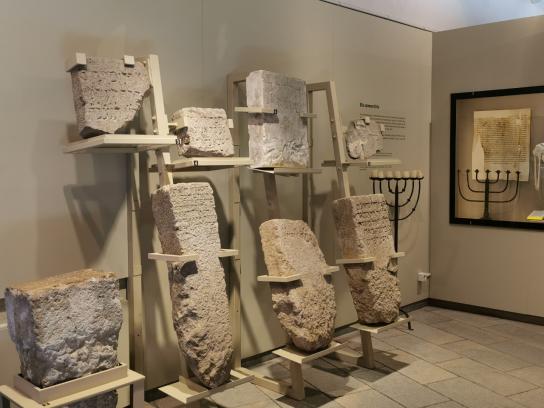
A Castelló d’Empúries es conserva una important col·lecció lapidària hebrea procedent de l’antic fossar o cementiri hebreu medieval que avui es conserva en una de les sales del Museu d’Història Medieval de la Cúria-Presó. Aquestes peces, juntament amb la resta de la col·lecció del museu es podrà visitar amb descompte si veniu acompanyats. Una magnífica oportunitat per visitar el museu i els seus entorn.

Conférence de Konstanty Gebert, journaliste, fondateur du mensuel juif polonais Midrasz et membre du Mouvement pour le renouveau de la vie juive en Pologne : éléments historiques sur la Varsovie d’hier, avant/ après la Shoah (avec/sans les Juifs), et état de la vie juive en Pologne aujourd’hui.
Présentation-vernissage de l’exposition Varsovie, ville des vivants, ville des morts par son curateur Pawel Freus, en partenariat avec l’Institut polonais et le musée du Ghetto de Varsovie (Exposition du 12 au 18 novembre)
Entrée libre sans réservation

Slovenian Schindlers – Slovenian righteous among nations”15.6.-15.12. 2023
We started announcing the program already in mid-June, when we opened the exhibition: “Slovenian Schindlers – Slovenian righteous among nations” on the benches on Križevniška Street in Ljubljana, where the Jewish Center is located, which is dedicated to 16 righteous Slovenians who Holocaust risked their lives to help Jews survive. The exhibition will be open all year until Hanukkah.
The limits of human responsibility for fellow human beings are one of the most important issues of our time. The notion of responsibility derives from human rights. How many times have we heard the words, “this is none of my business,” “I was forced into this”? Each time it’s about a man trying to shift responsibility for something he did to another.
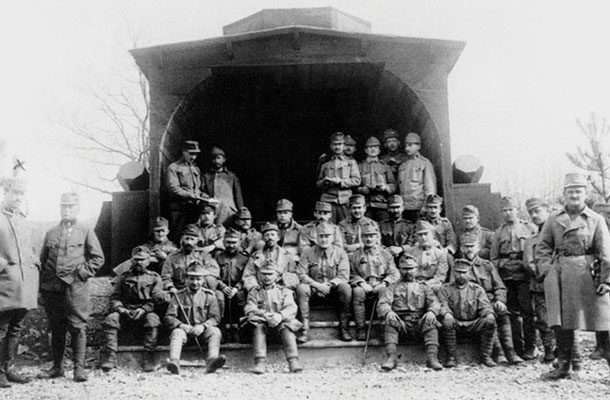
Opening of the exhibition Jewish Soldiers of The Austro-Hungarian Empire on the Isonzo Front
In 2024, we will commemorate the centenary of the start of the First World War.
Twenty years later, the Second World War followed, so the first has not been treated to the extent that would have been important and necessary. As many Jews lived in Prekmurje at the turn of the 19th century, they also had to go to war: some of them became officers. The data on them is not yet definitive and is also unreliable, so we do not know how many of them were victims or how many died.The First World War involved no less than 36 countries. The bloody fighting at the Battle of Isonzo (1915-1917) thus bore a multinational as well as a multi-religious stamp.

Opening of the first permanent exhibition on the Holocaust – Holocaust in Ljubljana- 1.9.2023
On Friday, 1 September at 6 pm, the President of the Republic of Slovenia, Mrs Nataša Pirc Musar, will open the first permanent exhibition on the Holocaust – Holocaust in Ljubljana, which is being prepared by the Jewish Cultural Centre Ljubljana and the Ljubljana City Museum.
The exhibition is curated by Dr Blaž Vurnik and designed by visual artists Miran Mohar and Vadim Fishkin.
Their new installation “Amsterdam”, dedicated to the Slovenian victims of the Holocaust, will also be on display on this occasion.
The evening will continue with a Shabbat service led by our Rabbi Alexander Grodensky and Cantor Nikola David. In the evening, there will also be a special ceremony on our street, with a rich programme including a puppet show for the youngest children, A Visit to the Sun, and a concert by the Anbot group with klezmer and Ladino music.

La GALERIE SAPHIR présente le projet « Mémoire » d’Inna Sandler.
Le thème « Mémoire » coïncide avec la convention sur le patrimoine culturel immatériel de l’Unesco : chacun de nous porte l’espoir de comprendre et de continuer à faire vivre les patrimoines transmis par notre famille… Nous y recherchons les réponses aux questions sur le sens de la vie.
Le projet « Mémoire » d’Inna Sandler se base sur les images (peintures et installations, accompagnées de textes documentaires et de documents originaux de personnes réelles, ses proches, des membres de sa famille, juifs d’Europe (Ukraine) et d’Asie Centrale… leurs vies, leurs destins individuels s’imbriquent dans la mémoire historique de toute l’Humanité.
L’histoire de l’époque a gravement affecté le sort de chacun d’entre eux depuis la Grande Famine en Ukraine à la dékoulakisation de Joseph Staline, la Seconde Guerre mondiale et la Shoah.

Members of the public are invited to visit the Milton Keynes and District Reform Synagogue in Giffard Park for a Heritage Open Day event on 10 September, 2023. There will be tours of the synagogue, a chance to view our Torah Scrolls (sacred scrolls), a multi-media exhibition and light refreshments.
The Jewish community in Milton Keynes is nearly 50 years old. Our synagogue building is over 20 years old. Our community comes from a wide geographic area stretching from Northamptonshire to Bedfordshire. We also come from surprisingly varied ethnic origins. Besides the common factor of being Jewish, we are also European, Middle Eastern, North American and South African in origin, bringing together our different Jewish traditions.
This event is also part of the Milton Keynes Heritage Open Days, the theme of which is “Creativity”.


The exhibition about the Szenwic family will present the fate of one of the Jewish families associated with Płock.
The Szenwic family was associated with Płock from the beginning of the 19th century, when the spice merchant Jakub Lewin Szenwic settled here. His sense of doing business made him join the group of wealthy Jewish merchants of the city of Płock in a short time. An important area of his activity was charity and involvement in the life of the Jewish community of Płock. He was elected a member of the synagogue supervisory board several times, and in 1834 he became a member of the Committee of the Jewish Hospital of the Płock Province, whose task was to establish a hospital for Jewish patients in Płock.